Chidanand Tripathi
@thetripathi58
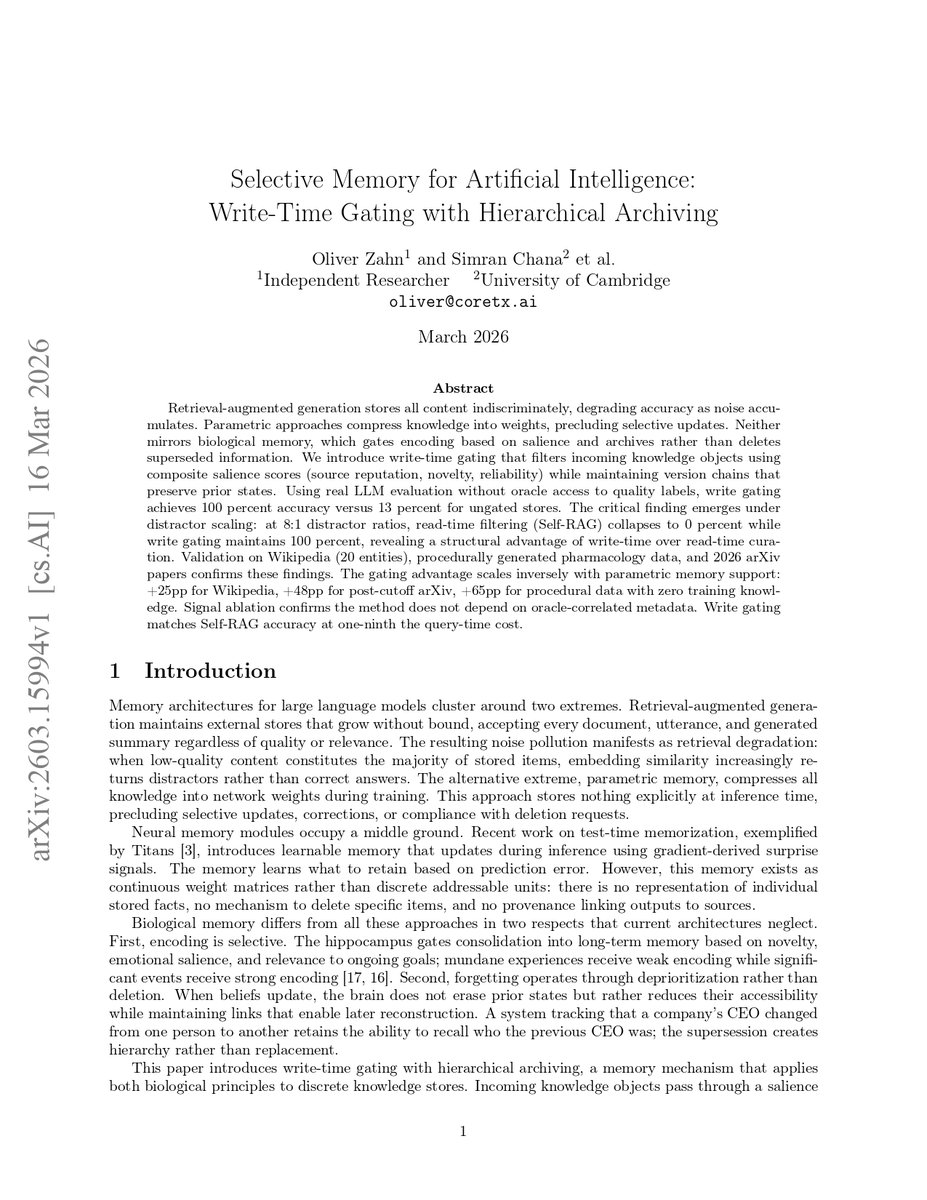
🚨 Cambridge researchers just tested what happens when you overload an AI's memory with irrelevant data. They found a complete collapse of modern RAG systems. Not a minor hallucination. A total failure of the exact retrieval architecture that every enterprise AI relies on to access private data. The models simply drowned in the noise. The researchers tested standard Retrieval-Augmented Generation (RAG) and filtering models like Self-RAG. They fed them information but slowly increased the ratio of distracting, low-quality documents. Here is what they found. Current read-time filtering failed completely. When the ratio of distractors hit 8:1, the accuracy of standard RAG systems plummeted to 0%. The AI lost the ability to find the truth. It exposed a massive architectural flaw. We currently store every single document an AI reads, regardless of quality, and force the model to sort through the garbage at query time. It is highly inefficient and fundamentally broken. The biological fix. The researchers built a new system called "Write-Time Gating" modeled after the human hippocampus. Instead of saving everything, it evaluates novelty, reliability, and source reputation before the data is even stored. And then there is the finding that changes how we build AI: hierarchical archiving. When beliefs update, the system does not delete the old data. It deprioritizes it, maintaining a version history just like the human brain. The result? The write-gated system maintained 100% accuracy even at massive distractor scales, all while costing one-ninth the compute of current systems. The researchers made it clear. When you dump raw, unfiltered data into a database and expect the LLM to figure it out later, you are building a system designed to fail at scale. No reliable retrieval. No cost control. No accuracy guarantees. Nothing. Right now, companies are building massive vector databases, throwing every piece of corporate documentation into them, and assuming the AI will magically find the signal in the noise. Stop treating AI memory like a hard drive. Start treating it like a biological filter. Build the gate at the entrance, not the exit.