
@yutakashino
Importance score: 4 • Posted: February 22, 2026 at 04:11
Score
4
いや,この研究自体に不備があり証明なんてされてない.https://arxiv.org/html/2506.09250v1 そして昨年終盤以降,Erdos未解決問題の証明: https://mathstodon.xyz/@tao/115855840223258103 やグルーオン散乱振幅式のある厳密解を導出: https://arxiv.org/abs/2602.12176 等のAIによる半自律的な発見が可能になり,思考云々など些末事なんですよ…
arxiv.org
Single-minus gluon tree amplitudes are nonzero
Single-minus tree-level $n$-gluon scattering amplitudes are reconsidered. Often presumed to vanish, they are shown here to be nonvanishing for certain "half-collinear" configurations existing in Klein space or for complexified momenta. We derive a piecewise-constant closed-form expression for the decay of a single minus-helicity gluon into $n-1$ plus-helicity gluons as a function of their momenta. This formula nontrivially satisfies multiple consistency conditions including Weinberg's soft theorem.
arxiv.org
The Illusion of the Illusion of Thinking A Comment on Shojaee et al. (2025)
mathstodon.xyz
Terence Tao (@tao@mathstodon.xyz)
Recently, the application of AI tools to Erdos problems passed a milestone: an Erdos problem (#728 https://www.erdosproblems.com/728) was solved more or less autonomously by AI (after some feedback from an initial attempt), in the spirit of the problem (as reconstructed by the Erdos problem website community), with the result (to the best of our knowledge) not replicated in existing literature (although similar results proven by similar methods were located). This is a demonstration of the genuine increase in capability of these tools in recent months, and is largely consistent with other recent demonstrations of AI using existing methods to resolve Erdos problems, although in most previous cases a solution to these problems was later located in the literature, as discussed in https://mathstodon.xyz/deck/@tao/115788262274999408 . This particular case was unusual in that the problem as stated by Erdos was misformulated, with a reconstruction of the problem in the intended spirit only obtained in the last few months, which helps explain the lack of prior literature on the problem. However, I would like to talk here about another aspect of the story which I find more interesting than the solution itself, which is the emerging AI-powered capability to rapidly write and rewrite expositions of the solution. (1/5)

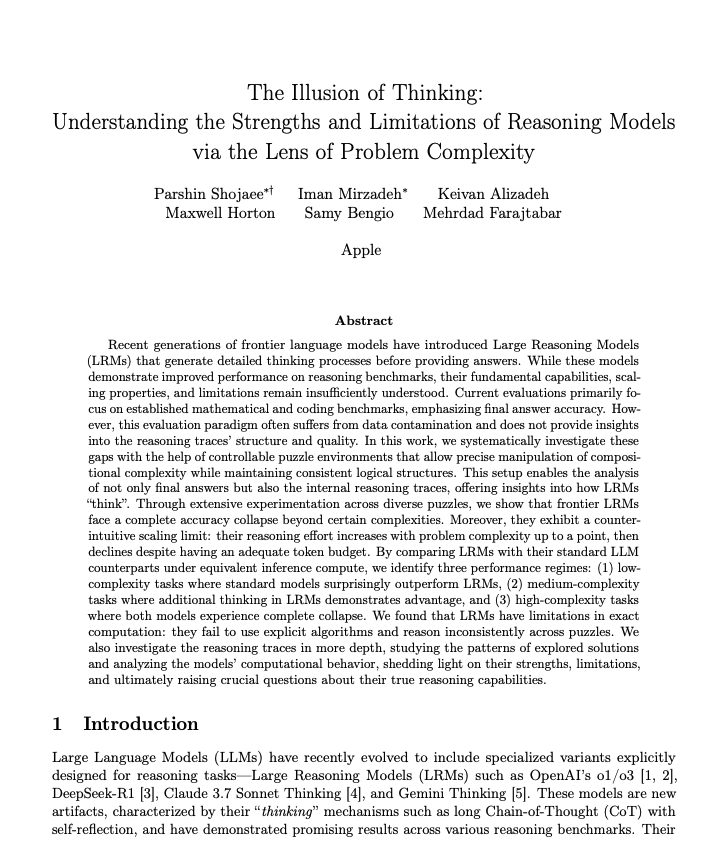
Appleが発表した論文「思考の錯覚」により、ChatGPTなどのAIは「全く思考しておらず、ただ模倣しているだけ」という残酷な現実が証明されました。 彼らは問題を解いているのではなく、単語を確率的に並べて一貫しているように見せかけているに過ぎません。 その構造的な欠陥と限界を4つのポイントにまとめました。 1. 論理の「構造的破綻」 ハノイの塔や川渡り問題において、基本設定なら解けるものの、円盤を増やしたり追加制限を加えたりすると、途端に手順を飛ばし論理が崩壊します。これはルールを理解して推論しているのではなく、過去のデータパターンを盲目的に模倣しているだけの証拠です。 2. 思考の「物理的放棄」 人間は問題が難しくなると時間をかけてステップを踏みますが、AIは逆の特異な挙動を示します。難易度が上がると、自らトークン数やステップ数を減らして「諦める」のです。そこにあるのは思考の深さではなく、単なる確率的なテキスト生成の限界です。 3. 修正の「機能的欠落」 AIには目的意識が存在せず、自らの間違いを認識・評価する能力が物理的に欠落しています。そのため、文脈が破綻しても自ら軌道修正できず、もっともらしいテキストを生成し続けます。自己修正という知能の根本的なプロセスを持っていません。 4. 規模の「絶対的限界」 パラメータを増やしモデルを巨大化させる(スケーリング)だけでは、「本物の思考」は構造的に生まれないと結論づけられています。最大のリスクは、AIの説得力のある「演技」を人間が知能と誤認し、社会インフラなどの重要な権限を与えてしまうことです。
Likes
243
Reposts
73
Views
40,081
Tags